The American healthcare landscape is currently facing a “perfect storm.” As we navigate through 2026, data from the National League for Nursing (NLN) and the American Association of Colleges of Nursing (AACN) suggests that while student enrollment remains resilient, the psychological toll on those in the pipeline has reached an all-time high.
For the modern US nursing student, the “crisis” isn’t just about long shifts; it is a grueling collision between high-stakes clinical rotations and a mountain of theoretical academic requirements. This duality often leads to “Academic Burnout,” which, if left unchecked, threatens the future of the US nursing workforce.
The Dual Burden: Clinical Intensity vs. Academic Rigor
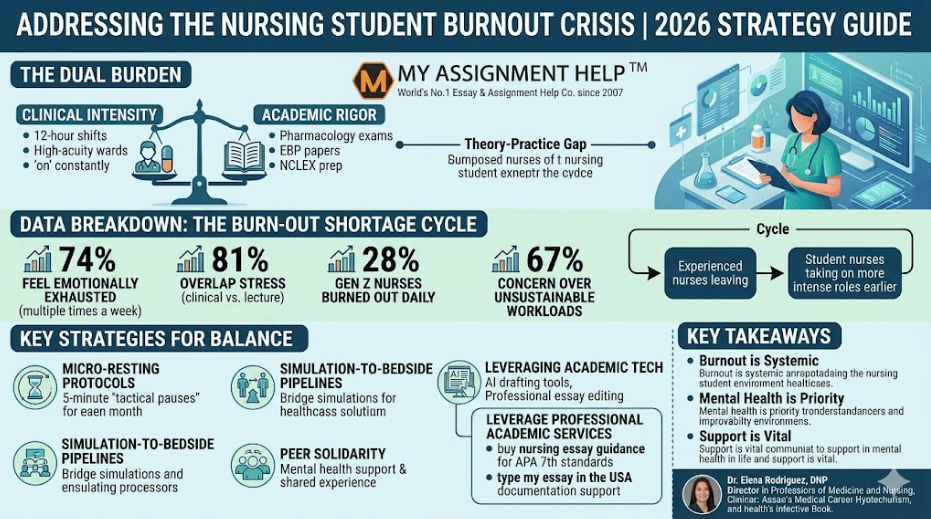
In the United States, nursing education is uniquely demanding. Unlike many traditional degrees, nursing requires students to be “on” in two different worlds simultaneously. On one hand, you have clinicals—12-hour shifts in high-acuity wards where the margin for error is zero. On the other, you have academics—complex pharmacology exams, evidence-based practice (EBP) papers, and the looming shadow of the NCLEX-RN.
The transition from a controlled classroom to a chaotic hospital floor often creates what educators call the “theory-practice gap.” According to 2025 survey data, nearly 74% of nursing students reported feeling emotionally exhausted multiple times a week. To manage this, many students seek digital support to streamline their documentation. For instance, when the clock is ticking on a 2,000-word care plan due the next morning, many find it necessary to type my essay in the USA using advanced drafting tools to help structure their thoughts and beat writer’s block. Using such resources allows them to focus more on clinical reasoning and less on the mechanical frustrations of drafting under extreme fatigue.
Data Breakdown: The Cost of the Nursing Shortage Cycle
The burnout crisis is not just a personal struggle; it is a systemic failure. The “Burnout-Shortage Cycle” is a well-documented phenomenon. As experienced nurses leave the bedside due to stress, student nurses are often pushed into more intense clinical scenarios earlier in their education to fill the gaps.
Key Statistics for 2025-2026:
- 67% of Students: Expressed deep-seated concern about managing unsustainable workloads.
- 28% of Gen Z Nurses: Report feeling burned out every single day.
- 54% of Students: Report severe anxiety or stress-related sleep disorders.
| Metric | Percentage | Source |
| Emotional Exhaustion | 74% | Nurse.org State of Nursing (2025) |
| Clinical-to-Lecture Overlap Stress | 81% | Academic Medicine Journal |
| Enrollment Growth | 1.2% | AACN Annual Report |
This data highlights why “resilience” is no longer a sufficient answer. Systemic support, such as mental health integration and flexible academic aids, has become a necessity. For students specializing in high-pressure fields like pediatrics or geriatrics, the academic writing load can be particularly punishing. In these cases, many choose to buy nursing essay guidance to ensure their research papers meet the rigorous APA 7th edition standards required by US nursing boards, allowing them to prioritize their physical rest and clinical performance.
Strategies for Balancing the Scales
- Micro-Resting Protocols: Studies show that even 5-minute “tactical pauses” during a clinical shift can reduce cortisol levels and prevent medication errors.
- Simulation-to-Bedside Pipelines: Many US nursing schools are now implementing “bridge simulations” to help students adjust to the sensory overload of a real hospital environment.
- Leveraging Academic Tech: Don’t let documentation be the “straw that breaks the camel’s back.” Use AI drafting tools and professional editing services to manage the heavy administrative side of a BSN or MSN program.
- Peer Solidarity: Data identifies “peer-to-peer solidarity” as the single most effective buffer against academic burnout.
Key Takeaways
- Burnout is Systemic: It is a result of the collision between clinical shortages and high academic standards.
- Mental Health is Priority: Nearly 1 in 4 Gen Z nurses feel burned out daily; students must seek help early.
- Support is Vital: Utilizing academic tools for essay drafting and nursing research is a valid strategy for time management and mental health preservation.
See also: Future of Decentralized Internet
FAQ Section
Q: Is it common for nursing students to feel burnout before they even graduate?
Yes. Modern data shows that “pre-professional burnout” affects over 60% of students due to the intensity of US clinical placements and concurrent testing schedules.
Q: How do clinical rotations contribute to academic failure?
The physical exhaustion from 12-hour clinical shifts often hinders a student’s ability to perform well in evening lectures or maintain the focus required for high-level research papers.
Q: Are there specific resources for American nursing students?
Absolutely. From the AACN mental health toolkits to specialized nursing essay services that focus on Evidence-Based Practice (EBP), students have more digital support than ever before.
Author Bio
Dr. Elena Rodriguez, DNP
Elena is a Senior Content Strategist and Academic Consultant at MyAssignmentHelp. With a Doctorate in Nursing Practice (DNP) and over a decade of experience in the US healthcare sector, she specializes in helping the next generation of nurses navigate the complexities of clinical documentation and academic research. She is a vocal advocate for student mental health and systemic reform in nursing education across North America.
